The Best Quarter They Ever Had, and Four Things It Does Not Tell You
- Nutanix closed FY2026 with record results on August 26: Q4 revenue of $757.1 million up 16 percent, ARR of $2.548 billion up 16 percent, and $840.7 million in full year free cash flow. Gartner then named them a Leader in Distributed Hybrid Infrastructure on September 10.
- Two numbers need your explanation before a customer finds them alone. The $1.27 billion GAAP net income is inflated by a one time $1.2 billion tax valuation allowance release, and the FY2027 revenue guide of about 12 percent sits below 16 percent ARR growth because contract duration moves revenue recognition.
- The most actionable item got no coverage at all. On September 8 management flagged rising hardware costs and supply chain constraints, which lands on your BOM and not their P and L. Quote the funded designs now, and get the quote validity window in writing.
Three months is a long time between posts, and I am not going to pretend otherwise. Here is what you missed, compressed into the parts that change what you say in a customer meeting this week.
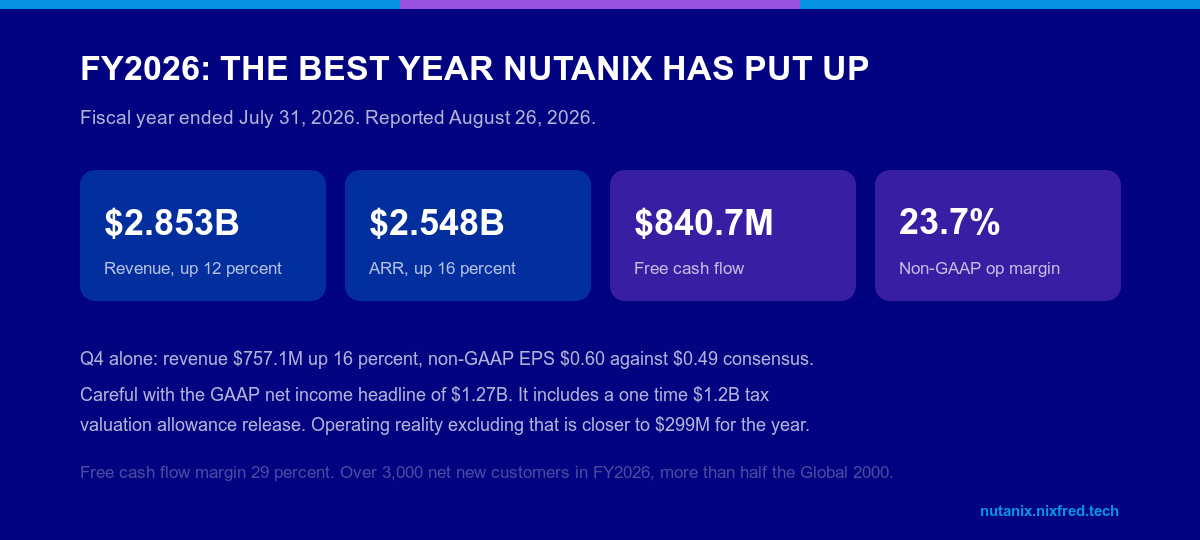
On August 26 Nutanix closed out fiscal 2026 with the best quarter and the best year in company history. Revenue of $757.1 million in Q4, up 16 percent. ARR of $2.548 billion, up 16 percent. Free cash flow of $840.7 million on the full year, a 29 percent margin. Non-GAAP EPS of $0.60 against a $0.49 consensus. The stock jumped about 8 percent after hours and finished August up more than 16 percent. Then on September 8 and September 10, Gartner named them a Challenger in Container Management and a Leader in Distributed Hybrid Infrastructure.
That is a genuinely great quarter and you should say so. But a great quarter is not the interesting part of this conversation. The interesting part is the four things sitting underneath it that your customers are going to find on their own if you do not raise them first.
The GAAP Number That Will Embarrass You If a CFO Finds It First
What happened: the headline GAAP net income for Q4 was $1.27 billion. For a company that did $757 million in revenue that quarter. If that math bothers you, good, it should.
The explanation is clean and boring: Nutanix released a US deferred tax valuation allowance, which dropped roughly $1.2 billion of one time, non cash benefit into the GAAP line. Strip it out and Q4 GAAP net income is around $61 million. For the full year it is about $299 million rather than the $1.5 billion headline.
The objection you will hear: nothing, at first. That is the problem. Then three weeks later a finance person pulls the 8-K, sees a billion dollar swing that does not reconcile to anything operational, and quietly decides the vendor was spinning them.
How to respond: get there first. When you show the FY26 numbers, show the operating numbers and say out loud that the GAAP figure includes a one time tax item. It takes nine seconds. It buys you the benefit of the doubt for the rest of the deal. I would rather be the person who explained the asterisk than the person who got caught omitting it.
What to tell your customer: quote ARR, free cash flow, and operating margin. Flag the GAAP number as tax driven before anyone asks.
Recurring Revenue Is Growing 16 Percent. The Guide Says 12.
What happened: ARR grew 16 percent in FY26. The FY27 revenue guide is $3.18 billion to $3.23 billion, which is about 12 percent at the midpoint. Total contract value bookings grew in the high teens, faster than revenue. And average contract duration in Q4 came in at 3.3 years, which CFO Rukmini Sivaraman called a bit lower than expected, with guidance for meaningfully higher in Q1 FY27.
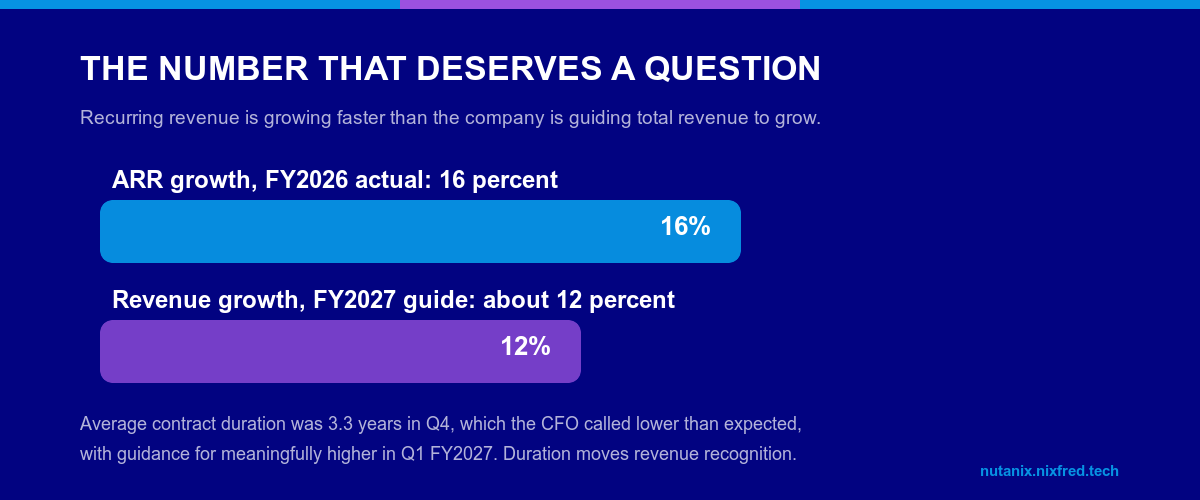
Why this matters to you and not just to an equity analyst: contract duration is the dial that moves how much of a deal lands as upfront revenue versus ratable. When duration moves, reported revenue moves in ways that have nothing to do with whether customers are buying. A conservative guide with accelerating ARR underneath it usually means the company is being careful about the accounting, not pessimistic about demand.
The objection you will hear: your vendor is guiding to slower growth, is the Broadcom migration wave over?
How to respond: point at ARR and TCV bookings, both growing faster than the revenue guide. Those are the demand signals. Revenue growth is the accounting output. If the underlying demand were softening, ARR would soften first, and it accelerated instead.
The caveat to be upfront about: I do not have visibility into how much of the FY27 guide assumes longer durations versus genuine demand, and neither does anyone outside the company. If a customer pushes hard on this, the honest answer is that it is a reasonable question to put to Nutanix directly. Do not manufacture confidence you do not have.
What to tell your customer: ARR up 16 percent and bookings up high teens are the demand signal. The 12 percent guide is an accounting posture, not a demand forecast.
The Hardware Warning That Did Not Make Any Headlines
What happened: at the Goldman Sachs Communacopia conference on September 8, Rajiv Ramaswami and Rukmini Sivaraman flagged higher hardware costs and supply chain constraints as a near term headwind. It got almost no coverage because it is not a product announcement and it is not an earnings number.
It is also the single most actionable thing in this entire post.
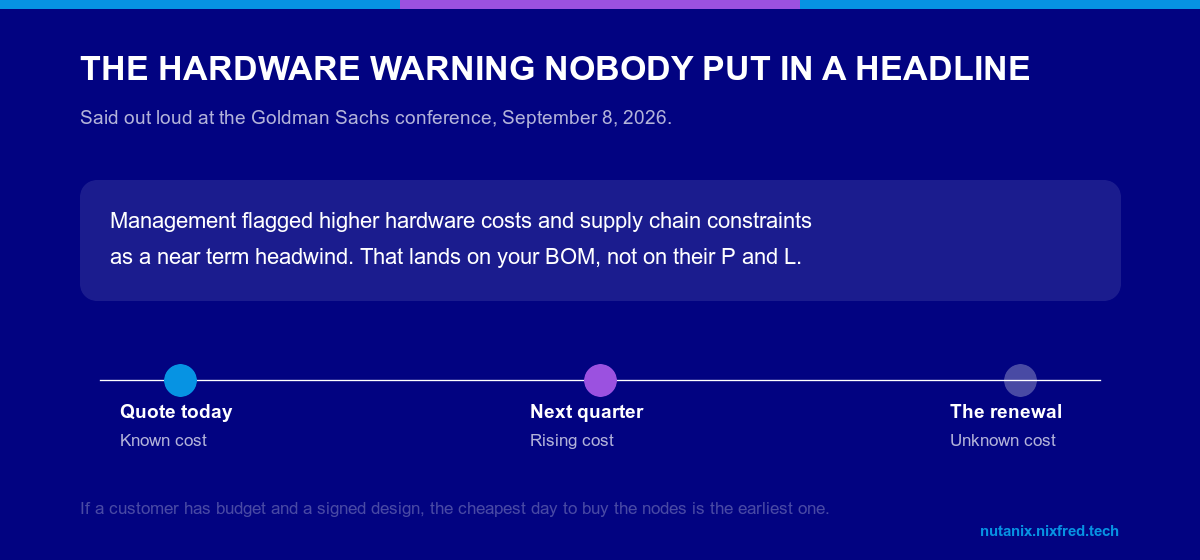
When the vendor says hardware costs are rising, that does not land on their income statement. It lands on your bill of materials. Memory and NVMe pricing has been climbing across the industry all year, and node pricing follows it with a lag.
How to use this: go through your pipeline this week and find every opportunity where the design is settled and the budget exists but the quote has not gone out. Those are the ones to move. Not with fear, just with arithmetic: the quote in front of you reflects today's component costs, and the vendor has publicly said costs are heading up.
While you are there, ask your Nutanix and OEM contacts two specific questions: how long is a quote honored, and is there price protection for deals already in flight. Get the answer in writing. If a customer signs in November against an October BOM, you want to know today whose problem the delta is.
What to tell your customer: if the design is done and the money is real, the cheapest day to buy nodes is the earliest one. Ask me for the quote validity window in writing.
AOS 7.3 Maintenance Ends in Twenty Days
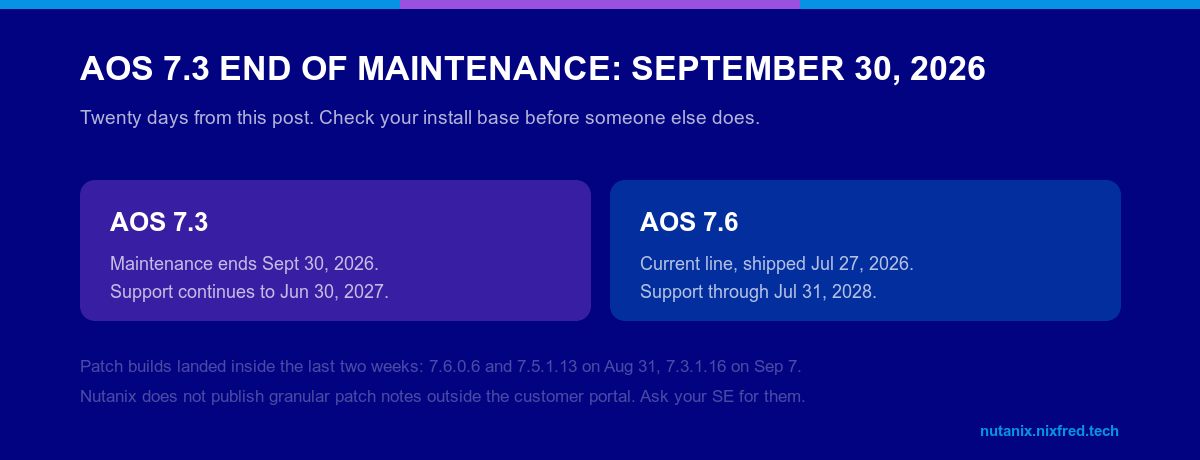
What happened: AOS 7.3 hits End of Maintenance on September 30, 2026. Support continues through June 30, 2027, but maintenance stopping is the part that matters, because it is the point where you stop getting fixes. AOS 7.6 shipped July 27 and runs through July 31, 2028, with AHV 11.2 and Prism Central 7.6 alongside it.
This is the least glamorous item here and the one most likely to actually generate work. Run your install base. Find every cluster still on 7.3. Those are upgrade conversations you can start this week with a real date attached, which is the easiest kind of conversation to start.
One honest annoyance worth naming: three patch builds landed in the last two weeks, 7.6.0.6 and 7.5.1.13 on August 31 and 7.3.1.16 on September 7, and Nutanix does not publish granular patch notes outside the customer portal. If a customer asks what changed, you have to go ask your SE. That is a friction point, not a scandal, but do not pretend the information is public when it is not.
What to tell your customer: anything still on AOS 7.3 stops getting maintenance fixes September 30. Let us scope the 7.6 upgrade now while it is a plan and not an incident.
Yes, They Cut 5 Percent. Answer It Directly.
What happened: on August 4, three weeks before the blowout quarter, Nutanix announced a 5 percent workforce reduction, roughly 390 people, with $33 million to $43 million in charges, substantially complete by the end of October. The framing was reallocation toward AI, modern apps, external storage, and customer facing sales.
Back in May I wrote that is Nutanix safe had become one of the two questions every SA gets. This is the FY27 version of that question, and the layoff plus the record quarter is a genuinely confusing pair of facts if you only see the headlines.
The objection you will hear: they just cut 5 percent of the company. Are they in trouble? Who is going to support us?
How to respond: take the question seriously instead of waving it off. A company with $840 million in free cash flow and 16 percent ARR growth is not cutting to survive, it is cutting to reallocate. That is a real and defensible distinction. But the second half of their question is the fair one, and the answer is not in a press release. Find out who covers that account today, confirm the named SE and TAM have not changed, and tell the customer the actual names.
The caveat to be upfront about: I do not know the function level breakdown of those 390 roles, and Nutanix has not published one. If someone asks me whether support headcount was touched, I say I do not know and I will find out. That answer has never once cost me credibility. Guessing would.
What to tell your customer: this was reallocation, not distress, and here are the names of the people on your account today.
Ten Questions I Am Taking Into a Nutanix Meeting
I am sitting down with Nutanix in person this afternoon. These are the questions I am bringing. Five on the business, five on the technology, all built on news from the last two weeks. Steal them.
Five Business Questions
1. ARR grew 16 percent but FY2027 revenue is guided to about 12. Rukmini called Q4 contract duration of 3.3 years lower than expected and guided meaningfully higher for Q1. How much of the 12 is a duration and revenue recognition assumption versus an actual demand view? If duration lands where you expect, does the guide have upside?
2. You cut 5 percent of the company on August 4, three weeks before a record quarter. Which functions absorbed those 390 roles, and specifically what changed in partner facing SE and channel coverage? I need to tell my accounts who supports them by name.
3. At Goldman Sachs on September 8 you flagged higher hardware costs and supply chain constraints. How long is a quote honored today, and is there price protection for deals already in flight? If a customer signs in November against an October BOM, whose margin absorbs the delta?
4. TCV bookings grew high teens, faster than revenue, and you added over 3,000 net new customers. What is the FY2027 split between new logo and expansion, and where does the partner channel actually get compensated on land versus expand? I want to point my team at whichever motion you are funding.
5. AMD put $150 million of equity in plus up to $100 million for engineering and go to market, and agentic AI is going onto AMD GPUs. Meanwhile every AI conversation I walk into assumes NVIDIA. What do you want partners quoting today, and does AMD get feature parity or does it trail?
Five Technical Questions
1. NAI 2.8 shipped multi-node, multi-GPU inference and KV-cache offload, both as tech preview. What is the interconnect requirement for tensor parallelism spanning nodes, RoCE, InfiniBand, or is plain NVMe over TCP enough? What is the measured token latency penalty when KV-cache spills from HBM to CPU memory, and at what context length does it start to hurt? What has to happen for those two to leave preview?
2. NKP 2.19 puts NKP directly on AHV with Flow doing network level sandboxing. NKP 2.18 already shipped Istio ambient mode, and Kubernetes has NetworkPolicy. That is potentially three enforcement planes on the same traffic. Are Flow and NetworkPolicy independent, and if a Flow rule and a NetworkPolicy disagree, which one wins and where do I see that decision logged?
3. The AI Applications Catalog in 2.19 lists Kubeflow, Milvus, and Slurm as one click deploys. Are those Nutanix supported artifacts or community manifests with a Nutanix installer on top? Concretely, when Milvus has a CVE, who ships the patched image and on what SLA? And what does the CNCF Kubernetes AI Conformant certification actually assert, since it is being used as a proof point?
4. Files 5.4 added TLS and mTLS encryption for NFS. Which NFS versions does that cover, is Kerberos still required for authentication or does mTLS replace it, and what is the throughput cost on a loaded file server? I also want to know whether encrypted NFS blinds Files Analytics or the ransomware detection, because if the inspection point is in the clear path, encryption may cost me a security feature.
5. Objects 5.3.1.1 shipped CVE fixes bundled into MSP 3.0.1.8, auto applied during upgrade. The microservices platform is shared underneath Objects, Files, and NKP. What is the blast radius when MSP moves? Can I stage an MSP upgrade independently of the Objects upgrade, does it force a rolling restart of the other services riding on it, and what is the rollback path if it goes wrong?
Two of those are deliberately built on gaps rather than facts. Nobody can confirm the CVE identifiers behind that Objects release from public sources, and the AI catalog support model is not documented publicly. If they answer those crisply, you learn something real. If they cannot, that is also an answer.
What Belongs on the Whiteboard
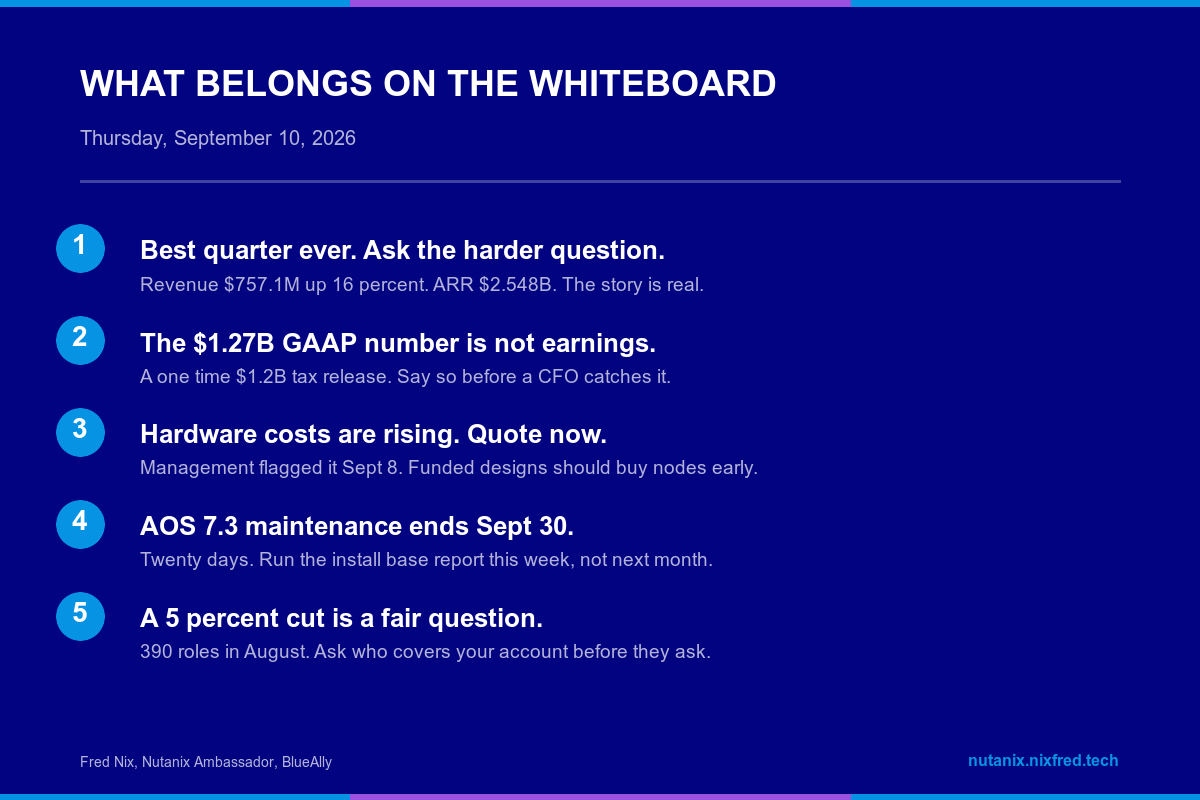
1. Best quarter ever. Ask the harder question. Revenue $757.1 million up 16 percent, ARR $2.548 billion. Lead with it, then go straight to what it does not tell you.
2. The $1.27 billion GAAP number is not earnings. It is a one time $1.2 billion tax valuation allowance release. Say it before a CFO finds it.
3. Hardware costs are rising. Quote now. Management said it out loud on September 8. Every funded design with a settled BOM should move this week.
4. AOS 7.3 maintenance ends September 30. Twenty days out. Run the install base report this afternoon and turn it into upgrade conversations.
5. A 5 percent cut is a fair question. 390 roles in August, three weeks before a record quarter. Reallocation, not distress. Bring the names of who covers the account.
The through line across all five: Nutanix is winning, and the honest version of that story is more persuasive than the polished one. Every item on that card is something a customer could find without you. Being the person who raised it first is the entire job.
- Nutanix Reports Fourth Quarter and Fiscal 2026 Financial Results | Nutanix Investor Relations
- Nutanix Q4 FY2026 results, SEC Form 8-K Exhibit 99.1 | SEC EDGAR
- Nutanix at Goldman Sachs Communacopia: cloud push gains pace | Investing.com
- Nutanix Recognized as a Leader in the Gartner Distributed Hybrid Infrastructure Magic Quadrant | GlobeNewswire
- Nutanix Recognized in 2026 Gartner Magic Quadrant for Container Management for Second Consecutive Year | GlobeNewswire
- Nutanix Inc. reports material event, Form 8-K | SEC filing via StockTitan
- AOS 7.6, AHV 11.2 and Prism Central 7.6 release | Nutanix Next community
- Nutanix AOS end of life and end of maintenance dates | EOSL.date
- Why Nutanix Stock Ascended in August | The Motley Fool